
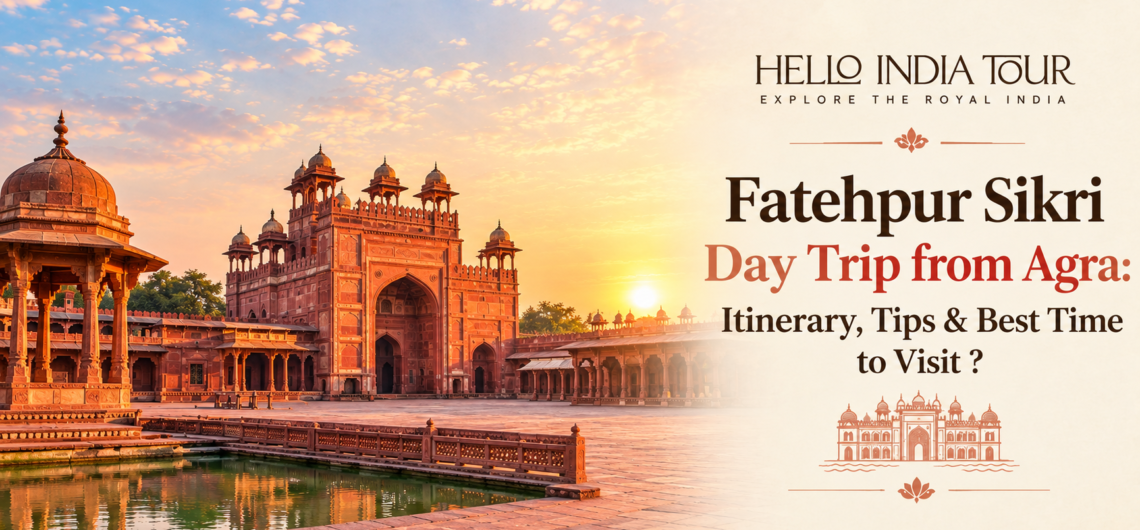
Most Agra itineraries revolve around two names: Taj Mahal and Agra Fort. Fatehpur Sikri barely gets a mention, even though it sits just 35-40 km away and was once the actual capital of the Mughal Empire. So is it worth carving out time for, or is it a detour you can skip?
Quick Facts
- Distance from Agra: 35-40 km (about 45 minutes to 1 hour by road via NH-11)
- Time needed on-site: 1.5 to 2 hours
- Total time commitment: Half a day, easily combined with other Agra sightseeing
- Built by: Emperor Akbar, starting 1571
- Capital status: Served as the Mughal capital from 1571 to 1585
- UNESCO status: World Heritage Site
- Why it was abandoned: Most likely a water shortage, though a military campaign in Punjab also pulled Akbar away permanently
Why Fatehpur Sikri Gets Overlooked
Unlike the Taj Mahal or Agra Fort, Fatehpur Sikri isn’t in Agra itself — it’s a separate town, which makes it feel optional even though the drive is short. It also doesn’t have a single iconic structure the way the Taj does, so it’s harder to sell in a quick photo. What it does have is one of the best-preserved Mughal cities anywhere in India, built and abandoned within about 15 years, frozen in a way Agra Fort and the Taj aren’t.
If you have half a day free in your Agra schedule, this is the stop most people regret skipping.
What You’ll Actually See
Fatehpur Sikri is a full complex, not a single monument, so it’s worth knowing what you’re walking into:
Buland Darwaza: The main gate to the Jama Masjid, and one of the tallest gateways in India. Built to commemorate a military victory, it’s the first thing that makes clear this was never meant to be a modest town.
Jama Masjid: A working mosque within the complex, still used today. Large courtyard, multiple domes, and genuinely peaceful if you visit outside prayer times.
Tomb of Salim Chishti: A white marble tomb inside the mosque courtyard, dedicated to the Sufi saint whose blessing Akbar credited for the birth of his son. Visitors still tie threads to the marble screens here as a wish-making ritual — it’s one of the few spots in the complex that feels alive rather than purely historical.
Diwan-i-Khas (Hall of Private Audience): Recognizable by its unusual central pillar, carved with brackets that support a platform where Akbar reportedly sat to hear advisors from four different faiths — Islam, Hinduism, Christianity, and Zoroastrianism — debate in front of him.
Panch Mahal: A five-story, open-sided pavilion with progressively smaller floors, believed to have been used by the women of the court to enjoy the breeze away from public view.
Jodha Bai’s Palace: The largest residential structure in the complex, built for Akbar’s Rajput wife, blending Hindu and Islamic architectural styles in its carvings and layout.
Give yourself 1.5 to 2 hours to see these properly without rushing.
Timings and Entry
- Open: Sunrise to sunset, all days of the week
- Best arrival time: Mid-morning, after the Taj Mahal if you’re combining both in one day
- Entry fees: Charged separately for Indian and foreign visitors, following the same ASI ticketing structure as other monuments in the region — check current rates before you go
- Guide recommended: Fatehpur Sikri has less signage than the Taj or Agra Fort, so a guide adds real value in understanding what you’re looking at
Best Time to Visit
October to March is ideal, same as the rest of Agra — cooler mornings make the walk between structures far more comfortable, since much of the complex is exposed sandstone with little shade.
Avoid midday in summer months. The stone courtyards heat up fast, and there’s minimal shelter between the major structures.
Early morning or late afternoon light works best for photography, especially around Buland Darwaza and the Panch Mahal’s open arches.
How to Fit It Into Your Agra Trip
If you’re doing Agra as a day trip from Delhi: Fatehpur Sikri is a stretch — you’d be adding an extra hour of driving each way on top of the Taj and Agra Fort. Only add it if you’re not also trying to get back to Delhi the same evening.
If you’re spending a full day or two in Agra: This is exactly where Fatehpur Sikri fits. Taj Mahal and Agra Fort on day one, Fatehpur Sikri on day two — ideally on your way out of Agra if you’re continuing to Jaipur, since it sits roughly in that direction.
If you’re on the Golden Triangle route: Fatehpur Sikri works well as a stop between Agra and Jaipur rather than a separate round trip from Agra, saving you the return drive entirely.
Common Mistakes Travelers Make
Treating it as a quick photo stop. Fatehpur Sikri rewards a proper walk-through. Rushing it in 20 minutes means missing the Diwan-i-Khas pillar and the thread-tying ritual at Salim Chishti’s tomb, which are the most memorable parts.
Not budgeting the extra hour of driving. It’s a short trip, but it’s still an hour each way that needs a slot in your schedule — don’t assume you can add it “for free” onto an already packed Agra day.
Skipping a guide. More than almost any other Agra-area site, Fatehpur Sikri’s story — a capital built and deserted within 15 years — needs context to land. Without it, you’re looking at empty sandstone buildings.
Wearing sandals on a hot day. Long stretches of exposed stone courtyard get uncomfortably hot underfoot by late morning in warmer months.
Frequently Asked Questions
Is Fatehpur Sikri worth visiting from Agra?
Yes. It’s a short drive, roughly 45 minutes to an hour, and offers one of the best-preserved Mughal-era complexes in India. Most travelers who skip it do so simply because it’s not as famous as the Taj Mahal, not because it isn’t worth seeing.
How much time do I need at Fatehpur Sikri?
1.5 to 2 hours for the main structures — Buland Darwaza, Jama Masjid, Salim Chishti’s tomb, Diwan-i-Khas, and Panch Mahal.
Can I visit Fatehpur Sikri and the Taj Mahal in one day?
Yes, but it makes for a long day. It works best if Fatehpur Sikri is your last stop before heading toward Jaipur, rather than a there-and-back trip squeezed in alongside the Taj and Agra Fort.
Is Fatehpur Sikri open every day?
Yes, it’s open daily from sunrise to sunset, unlike the Taj Mahal, which is closed on Fridays.
Do I need a guide at Fatehpur Sikri?
Not required, but strongly recommended. The complex has less on-site information than other major monuments, and the history — Akbar’s interfaith debates, the reason the city was abandoned — is what makes the visit memorable.
Bottom Line
Fatehpur Sikri isn’t a detour in the sense of going out of your way for something minor — it’s a short, easy addition that rewards the extra hour with one of the most complete Mughal-era sites you can visit in India. If your Agra schedule has any flexibility at all, this is the stop worth making room for.






Comments